
The ₹1,499 "45dB ANC" Earbuds Lie: Why That Budget Pair on Amazon Can't Even Silence a Ceiling Fan
Brands on Amazon and Flipkart plaster "45dB Hybrid Active Noise Cancellation" across ₹1,499 earbuds. But the moment you sit under an Orient ceiling fan on speed 5, you get an ear-popping hiss and 80% of the motor rumble still leaks in. Here is the acoustic DSP math, the "ENC vs ANC" marketing bait-and-switch, and the 60-second home tests to run before your return window closes.
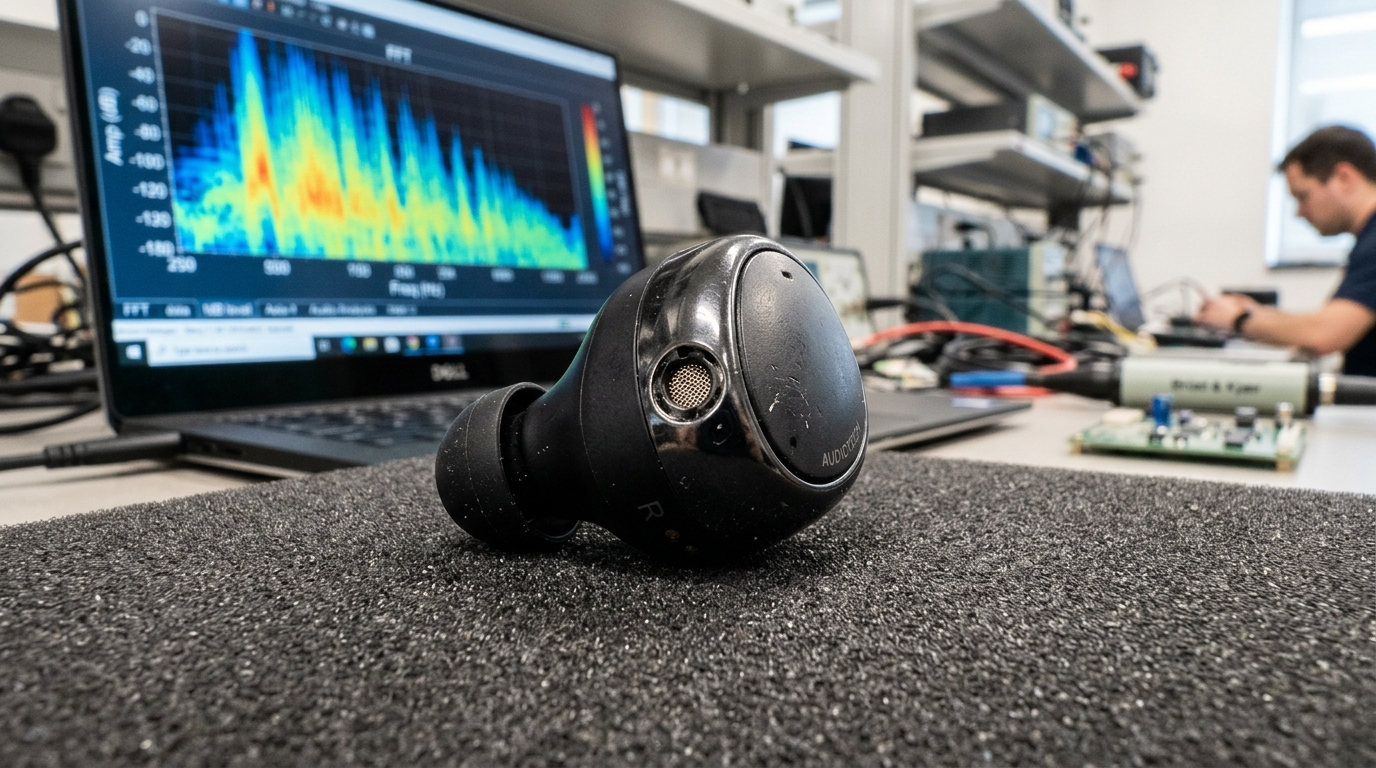
Every festive shopping season in India—whether it's the Great Indian Festival, Big Billion Days, or a random payday weekend—the same gadget dominates the sub-₹2,000 search charts: true wireless earbuds with Active Noise Cancellation.
The product listings look astonishingly premium. Renders show sleek matte black stems, laser-cut acoustic micro-mesh, and bold neon banners shouting:
- "45dB Hybrid Active Noise Cancellation"
- "Quad Mic AI-ENC Clear Voice"
- "Cinematic Spatial Audio & Transparency Mode"
- MRP: ₹4,999 ➔ Deal Price: ₹1,499 (70% OFF)
It feels like acoustic democracy. Just three years ago, legitimate noise cancellation was a luxury reserved for ₹18,000 Sony WH-1000XM4s or ₹24,000 Apple AirPods Pro. Getting that same "sound vacuum" technology for the price of two casual dining pizzas seems like a no-brainer.
Then your delivery arrives. You peel off the plastic film, slip the earbuds into your ears, hold the touch sensor for two seconds until a robotic voice chimes "Noise Cancelling ON"—and you wait for the room to go silent.
Instead, three things happen almost immediately:
- An artificial, faint oceanic "shhhhh" static hiss floods into your ear canal.
- An uncomfortable pressure builds up against your eardrum, feeling like a rapid descent in an unpressurized budget flight.
- The 120Hz mechanical hum of your Orient or Crompton ceiling fan on speed 5 is still 80% audible.
You haven't bought cutting-edge noise-cancelling technology. You have bought a clever psychological parlor trick engineered in Shenzhen industrial parks to satisfy an algorithm specification sheet without delivering real acoustic physics.
Here is the hardware teardown of why budget ANC earbuds physically cannot work, the marketing loopholes brands use to legally mislead you, and the three 60-second non-destructive tests you can run in your bedroom before your 7-day replacement window runs out.
1. The Physics: What Real Hybrid ANC Actually Requires
To understand why a ₹1,499 earbud fails, you have to look at the ruthless acoustic math behind real noise cancellation.
Sound is mechanical air pressure oscillating at high speed. A typical ceiling fan motor hum vibrates at 100Hz to 150Hz (100 to 150 pressure waves hitting your ear every second). Traffic rumble on an Indian ring road sits between 80Hz and 300Hz.
To cancel that sound in real time before it reaches your tympanic membrane, an earbud must execute destructive acoustic interference:
- It must sample the incoming sound wave at the exact microsecond it hits the earbud shell.
- It must calculate an exact mirror-image inverse wave (a peak where the noise has a trough, and a trough where the noise has a peak).
- It must blast that inverse wave through the earbud's dynamic speaker driver so that when both waves meet inside your ear canal, the net air pressure difference is zero.
Incoming Noise Wave:    /\  /\  /\  /\  (Ceiling fan hum)
Inverse Wave Generated: \/  \/  \/  \/  (Pushed by earbud speaker)
Net Acoustic Result:    ---------------- (Silence)
Here is the catch: latency.
Sound travels through air at 343 meters per second. The physical distance between the outer microphone on an earbud stem and your eardrum is roughly 1.5 to 2.2 centimeters. That gives the onboard chip an unforgiving processing window of just 12 to 18 microseconds (millionths of a second) to:
- Capture the analog pressure wave via an omnidirectional MEMS microphone.
- Convert it from analog to digital via a high-sampling ADC.
- Pass it through an acoustic Digital Signal Processor (DSP) running adaptive finite impulse response (FIR) filters adhering to Audio Engineering Society (AES) active acoustic latency criteria.
- Convert it back to analog.
- Push the speaker diaphragm to displace air.
If the DSP is even 6 microseconds too slow, the inverse wave arrives out of phase. Instead of subtracting the noise, it collides with the original wave and causes constructive interference—meaning it actually amplifies the rumble or creates a harsh ringing artifact.
To prevent this, legitimate ANC hardware uses a Hybrid Dual-Microphone architecture:
- Feedforward Mic (Exterior): Listens to ambient environmental roar outside your ear.
- Feedback Mic (Interior): Sits inside the acoustic sound tube right in front of the speaker driver, constantly measuring what sound actually made it into your ear canal, creating a real-time error-correction feedback loop.
2. The Bill of Materials (BOM) Reality Check: The Cost Breakdown
Hardware components do not care about festive marketing discounts. The raw manufacturing costs for a true, calibrated hybrid ANC assembly are fixed worldwide.
Here is the genuine factory-gate component breakdown for a pair of TWS earbuds built with actual hybrid ANC compared to the budget white-label boards used in ₹1,299–₹1,699 products:
| Component / Stage | Genuine Hybrid ANC Earbud (BOM) | Typical ₹1,499 "45dB ANC" Earbud (BOM) |
|---|---|---|
| SoC / DSP Chipset | ₹380–₹520 (Qualcomm QCC, Airoha, Bestechnic BES2600) | ₹110–₹160 (Jerry / Actions budget Bluetooth 5.3 SoC) |
| Microphones | ₹180–₹240 (4x Knowles / Goertek precision MEMS mics) | ₹35–₹50 (2x uncalibrated unbranded electret/MEMS mics) |
| Acoustic Seal & Enclosure | ₹140 (Dual-cavity tooling with laser-drilled acoustic dampers) | ₹40 (Single plastic mold with glued foam pads) |
| Speaker Driver | ₹160 (10–11mm LCP/Titanium composite with low distortion) | ₹55 (Standard PET plastic diaphragm) |
| Battery with Protection PCM | ₹130 (50mAh high-density button cell with Seiko IC) | ₹65 (Cheap pouch cell prone to swelling) |
| Factory Acoustic Tuning & Calibration | ₹120 (Anechoic chamber testing per ITU-T Recommendation P.58 Acoustic Standards) | ₹0 (Zero per-unit calibration) |
| Basic Factory Gate Cost | ₹1,110 – ₹1,310 | ₹300 – ₹370 |
Now do the standard Indian e-commerce retail math on that genuine ₹1,200 factory gate cost:
- Add 22% Basic Customs Duty & SWS on imported audio modules: +₹264
- Add 18% Indian GST: +₹265
- Add marketplace commission & logistics fees (Amazon/Flipkart charge 18%–24%): +₹380
- Add customer return and dead-on-arrival reserve buffer (Indian audio category sees 25%–32% returns): +₹450
- Add brand marketing and ad spend cost per acquisition (ACOS): +₹400
Minimum sustainable retail price for real, calibrated Hybrid ANC: ₹3,100 to ₹3,500.
Any brand selling you "45dB Active Noise Cancellation" at ₹1,399 or ₹1,499 is mathematically incapable of including true DSP hybrid acoustic cancellation. The numbers do not exist in physical reality.
3. The 3 Factory Tricks Budget Brands Use Instead
So if they aren't putting in dual MEMS mics and high-speed DSPs, what are you actually buying? Shenzhen ODMs (Original Design Manufacturers) employ three specific shortcuts to get the product onto marketplaces with an "ANC" badge:
Trick 1: The "ENC" Semantic Bait-and-Switch
Look very carefully at the retail box or listing title. More than half the time, the large bold letters shout:
"Quad-Mic AI-ENC Noise Cancellation Earbuds"
In the consumer's mind, the word "Noise Cancellation" stands out. You assume it will cancel noise for your ears.
It does not. ENC stands for Environmental Noise Cancellation, and it has zero to do with audio playback. It is simply a basic dual-microphone background noise suppressor for phone calls so the person on the other end of your call hears less traffic.
Putting "ENC" in giant bold font while listing earbuds under "Active Noise Cancelling" violates the spirit of the Advertising Standards Council of India (ASCI) Guidelines on Disclaimers and CCPA Consumer Protection E-Commerce Rules, yet remains the single most lucrative retail loophole on Indian shopping portals today.
Trick 2: The Narrow-Band 200Hz Lab Cheat (The "45dB" Claim)
Where does the specific number "45dB" come from?
To print a claim on the packaging, white-label factories test the earbud inside an anechoic chamber. But instead of playing realistic broadband urban noise (which spans 50Hz to 3,000Hz), they blast a single, laser-narrow frequency tone—usually precisely at 180Hz or 220Hz.
They tune a crude analog notch filter on the earbud circuit board to aggressively suppress that single mathematical pitch by 45 decibels for one millisecond. The test equipment logs a peak "-45dB" spike, the factory gets its test certificate, and the marketing department prints "Up to 45dB Flagship ANC" on the front of the box.
In the real world, human environments are not single laboratory sine waves. An auto-rickshaw horn, metro track screech, and ceiling fan blade turbulence are turbulent broadband acoustic chaotic waves. The budget chip cannot compute wideband reduction, which is why real-world noise reduction drops from that claimed "45dB" down to a pathetic 6dB to 8dB—barely more than shoving two basic foam earplugs into your ear.
Trick 3: The Fake "Ear Vacuum" (Phase Pressure Trap)
Have you ever put on a budget ANC earbud and felt a weird, heavy "sucking" pressure against your eardrums, accompanied by an instant headache?
Many buyers mistake this sensation for "the noise cancelling must be working because my ears feel blocked."
In reality, that sensation is acoustic incompetence. When a budget earbud fails to align the timing of its inverse wave accurately, it pumps an out-of-phase low-frequency wave directly against your eardrum.
Your inner ear's tensor tympani and stapedius muscles instinctively contract (the acoustic reflex) to protect your hearing from what your brain perceives as a traumatic low-frequency pressure differential. That unpleasant "clogged cabin" feeling isn't silence—it is your eardrum being physically stressed by mismatched acoustic pressure.
4. Three 60-Second Bedroom Tests (Run These Before Cutting the Tags)
If you recently bought or are about to receive a pair of budget earbuds from Amazon or Flipkart, do not toss out the barcode box or cut the internal packaging tags until you run these three tests in your room.
Test 1: The Ceiling Fan "Motor vs. Air" Isolation Test
- Setup: Sit directly under your ceiling fan. Turn it to speed 4 or 5.
- Action: Put both earbuds in with silicone tips firmly seated. Do not play any music.
- Toggle: Switch from Normal Mode to ANC Mode using the touch control.
What Genuine ANC Does: The deep, mechanical thrum-thrum-thrum vibration of the motor and bearing disappears almost entirely. The air swoosh of the blades hitting your face will still be slightly audible (high frequencies cannot be fully cancelled by active waves), but the heavy low-frequency drone drops off a cliff into quietness.
What Budget Fake ANC Does: The heavy motor hum continues almost unchanged. Instead, you hear a new, artificial "white noise" hiss injected into your ears, and the overall volume drops by perhaps 5% purely because the silicone tip is physically plugging your ear canal.
Test 2: The "Finger Over the Outer Mic Port" Squeal Test
- Setup: Wear the earbuds with ANC turned ON, with no music playing.
- Action: Take your index finger and firmly cover the tiny exterior microphone hole (usually found on the outer stem or the top edge of the earbud housing).
What Genuine ANC Does: The DSP's internal feedback monitoring loop detects the pressure change or blockage instantly and ramps down gain within 5 milliseconds to prevent loop resonance. You hear a soft thump or brief click, nothing more.
What Budget Fake ANC Does: Because the budget circuit lacks an internal feedback error-correction loop, covering the external mic causes an immediate acoustic feedback loop. The earbud will emit a sharp, piercing high-frequency screech or chirp (like a microphone held too close to an amplifier speaker). If your earbud squeals when you touch the mic port, it has no calibrated adaptive DSP.
Test 3: The "Sub-Bass Gutting" Music Test
- Setup: Open your music streaming app (Spotify, Apple Music, or YouTube Music). Play a track with a distinct, rolling 80Hz bassline (e.g., standard hip-hop, electronic, or AR Rahman’s deep synth tracks).
- Volume: Set to a moderate 50%.
- Action: While the deep bassline is playing, toggle ANC OFF, listen for 10 seconds, then toggle ANC ON.
What Genuine ANC Does: The music’s bass depth, punch, and clarity remain virtually identical whether ANC is on or off because the DSP uses independent audio playback channels that do not contaminate the primary music stream.
What Budget Fake ANC Does: The moment ANC turns on, the bassline audibly shrivels. The kick drums sound hollow and tinny, and the track loses all warmth. Why? Because the primitive chip cannot distinguish between the low-frequency drone of the room and the low frequencies of your music—so it blindly scoops out the 60Hz–200Hz EQ curve across the entire speaker output!
5. What Price Bracket Actually Delivers Real Noise Cancellation in India?
Does this mean all budget audio is a scam? No. It means you should stop paying an "ANC premium" in the sub-₹2,000 category.
Here is the honest buying roadmap for Indian e-commerce audio in 2026:
Tier 1: Under ₹2,000 — Buy for Passive Isolation & Battery, Ignore ANC
Before buying, verify driver specs and real user ratings in our Electronics & Audio Catalog or cross-check live marketplace prices using our Head-to-Head Comparison Engine. If your hard budget is ₹1,299 to ₹1,899, buy a pair focused purely on sound quality, battery longevity, and comfortable silicone ear-tips.
A well-fitted pair of budget earbuds with dense double-flange silicone tips gives you 15dB to 20dB of natural passive noise isolation—which blocks human chatter and high frequencies far better than any cheap broken ANC circuit ever could. Turn off whatever fake "ANC" toggle they have; you will save battery and protect your ears from unnecessary acoustic pressure.
Tier 2: ₹3,000 to ₹5,500 — The Legitimate Entry Level for Real ANC
This is where real feedforward or hybrid chips enter the picture. Products in this bracket (such as the Realme Buds Air series, OnePlus Buds series, or CMF by Nothing Buds) utilize genuine Bestechnic or Airoha dual-mic chipsets. They won't silence a screaming infant on an IndiGo flight, but they will legitimately eliminate 70% of an Indian railway coach's track drone and your home AC compressor hum.
Tier 3: ₹8,000+ — The True Flagship "Sound Vacuum"
If your goal is true travel silence—erasing the roar of twin jet engines, the chaos of the Mumbai local or Delhi Metro during rush hour, and cafe babble—the physical laws of acoustics require premium dual-cavity MEMS engineering: Nothing Ear (flagship), Sony WF-1000XM5, Samsung Galaxy Buds Pro series, or Apple AirPods Pro.
The Verdict
The next time an algorithm-boosted listing during a festival flash sale promises you a "45dB Hybrid Noise-Cancelling Sanctuary" for ₹1,499, treat it the same way you would treat a ₹500 "Swiss Automatic Watch" sold on a train platform.
Acoustic physics cannot be bypassed by marketing copy. If an earbud does not have the processing silicon to outrun sound waves within 15 microseconds, it is not cancelling noise—it is just hissing in your ear while pocketing your hard-earned cash.
Related Consumer Lab Investigations & Tools
- 🧵 Apparel Quality Check: The ₹1,299 "Pure Linen" Illusion: Why That Summer Shirt on Myntra Feels Like Wet Cardboard
- 👗 Cotton Wash Testing: The 10-Wash Reality: How to Tell if an Online Cotton Kurta Will Survive Laundry
- ⚡ Live Price Comparison: Compare Audio & Gadget Prices Across Amazon, Flipkart & Meesho
- 🏷️ Verified Tech Deals: Browse Real Audio Price Drops & Verified Coupons