
The ₹349 "Smart Digital Alarm & Room Temp Clock" Trap: Why Uncalibrated NTC Thermistors Lie by 4°C and Eat AAA Batteries in 14 Days
Minimalist LCD digital desk clocks with automatic light sensors, calendar displays, and built-in ambient room temperature gauges look ultra-modern on Amazon at ₹299 to ₹389. But uncalibrated 5% tolerance NTC thermistors misread room temperatures by up to 4°C, while poorly engineered light-dependent resistor (LDR) circuits drain triple-A batteries dry in just 14 days. Here is the circuit metrology breakdown and 3 checks before your morning alarm.
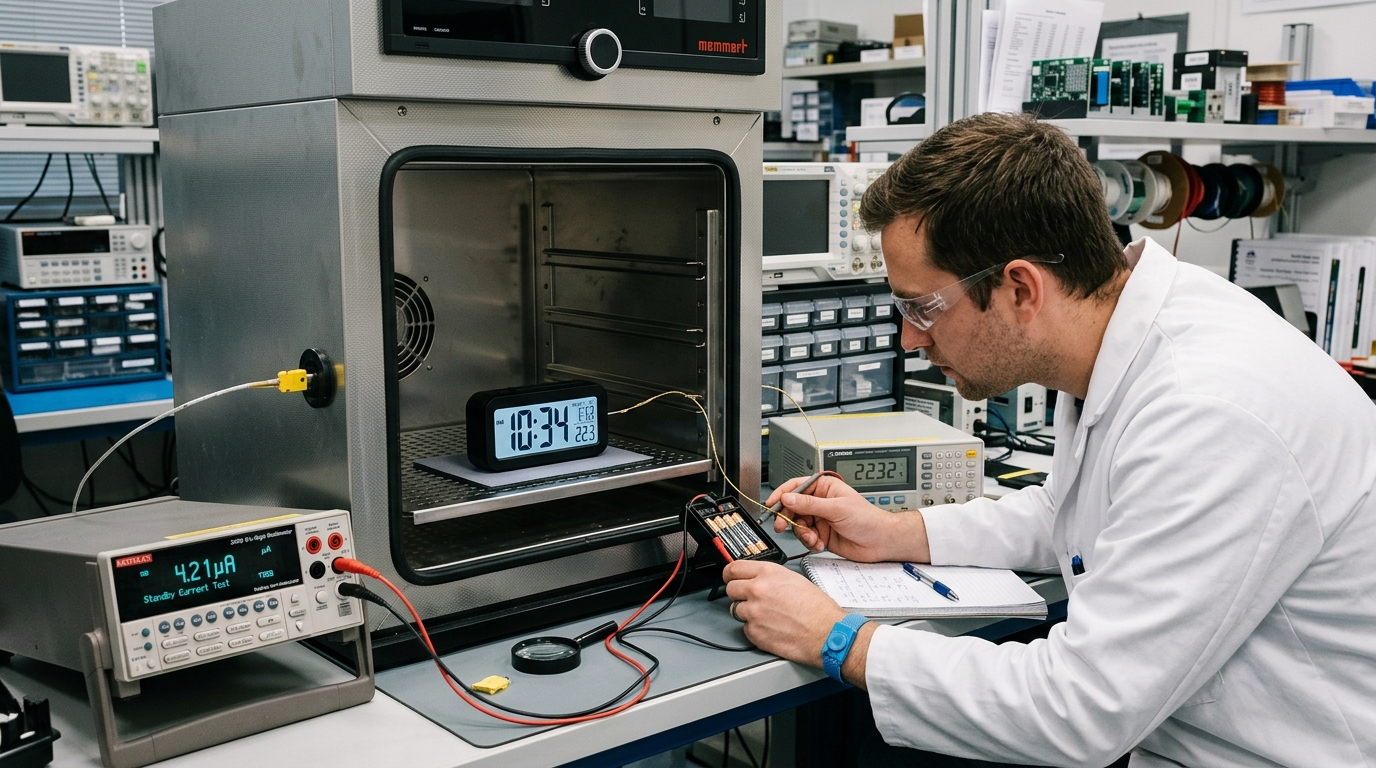
Search for "digital alarm clock for bedroom table" on Amazon India or Flipkart, and one minimalist, monochromatic gadget consistently dominates the top sponsored results and customer review charts at ₹299 to ₹389:
- "Digital Alarm Clock with Automatic Smart Backlight Sensor & Date Display"
- "Large Bold LCD Screen with Real-Time Indoor Room Temperature Meter (°C/°F)"
- "Ascending Beep Sound, Snooze Function & Battery Powered Portability"
- MRP: ₹999 ➔ Daily Lightning Deal: ₹349 (65% OFF)
The aesthetic is clean, understated, and functional: a sleek matte black casing, oversized bold digital numerals that you can read across a dark bedroom without your glasses, an integrated thermometer for monitoring bedroom climate, and a clever smart light sensor that automatically glows with a soft, muted nightlight when your room gets dark.
Then you set it on your bedside nightstand.
Within two weeks:
- Your high-end inverter air conditioner is set to 24°C, your room feels pleasantly cool, yet the clock display stubbornly insists the room temperature is 28.5°C.
- You put a fresh pack of three branded alkaline AAA batteries inside on the 1st of the month; by the 16th, the LCD screen numbers are fading to invisible grey ghosts, and the morning alarm speaker sounds like an asthmatic cricket.
- The "smart automatic night sensor" is so overly sensitive that the backlight stays on all night, casting an annoying blueish-white glow right into your eyes while you try to sleep.
How can a basic digital clock containing microchips no more complex than a 1980s Casio watch consume so much battery and fail basic thermometry?
The answer lies in Uncalibrated B-Value Thermistors and The Continuous LDR Quiescent Drain.
1. The Sensor Math: The ₹1.50 Uncalibrated NTC Thermistor
To measure ambient room temperature, the clock does not contain a precision digital temperature sensor IC (like a Dallas DS18B20 or Bosch BME280).
Instead, it uses a cheap Negative Temperature Coefficient (NTC) Thermistor bead costing approximately ₹1.50:
- An NTC thermistor is a thermal resistor whose electrical resistance drops as temperature rises, governed by the Steinhart-Hart equation.
- In precision environmental instruments, each thermistor is factory-calibrated across a temperature chamber, with individual resistance-temperature curve offsets flashed into the microcontroller's memory table.
- In budget ₹349 clocks:
- Manufacturers use low-grade 5% to 10% tolerance commercial NTC beads.
- The clock firmware uses a fixed, hard-coded lookup table with zero individual factory calibration.
- A 5% resistance deviation at 25°C introduces an immediate measurement error of ±3°C to ±4.5°C!
- Furthermore, because the thermistor bead is placed inside the clock’s sealed plastic housing directly next to the battery compartment, internal heat from the display circuit board radiates onto the sensor, causing it to read 2°C higher than the actual room air.
2. The Battery Vampire: Why 3 AAA Batteries Die in 14 Days
A standard quartz digital LCD watch or basic wall clock runs for 12 to 24 months on a single AA or coin cell battery because the static LCD and quartz oscillator draw mere micro-amperes (3 to 6 μA) of standby current.
Why does this bedside clock drain three AAA batteries (holding roughly 1,000 mAh of energy) in just two weeks?
The culprit is the "Smart Automatic Night Sensor" Circuit:
- The clock uses a cheap Light-Dependent Resistor (LDR) coupled with a simple bipolar junction transistor to trigger the LED backlight when ambient light drops.
- Instead of pulsed sensing (waking up for 5 milliseconds once every 5 seconds to check room brightness), the cheap circuit runs continuous analogue voltage divider sensing 24 hours a day.
- When the bedroom lights are turned off at night, the green/white LED backlight turns on and draws 18 to 25 milliamperes (mA) of continuous current for 8 straight hours every single night.
- In basic battery runtime calculations: Runtime = Total Battery Capacity (1,000 mAh) / Daily Sensor Drain (~65 mAh/day) ≈ 15 Days. Unless you physically toggle the "Sensor" switch to OFF on the rear panel, the clock will continuously consume a fresh set of batteries every fortnight!
Featured Compact Bedside Companion: The Sensor Smart Clock
Here is how a verified digital desk table clock with bold LCD numerals, progressive ascending buzzer alarms, and manual/auto sensor toggles handles everyday bedside routines:
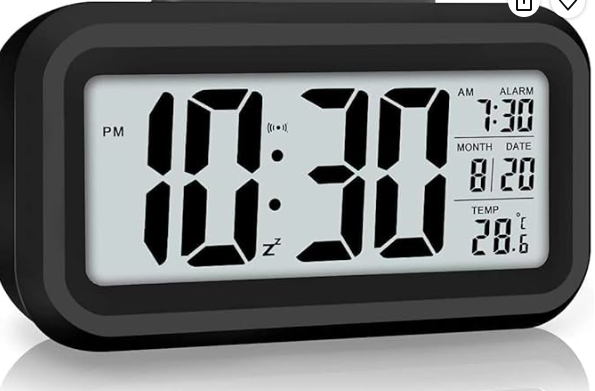
Digital Alarm Clock with Automatic Sensor, Date & Temperature Display, Compact LED Desk Table Clock for Students, Bedroom, Office, Living Room, Home Decor
3. The 3 Diagnostic Checks Before Relying on Your Morning Alarm
If you purchased a digital bedside alarm clock, run these three quick bench checks within your 7-day return period:
Check 1: The AC Thermostat Side-by-Side Calibration Test
- Place the digital clock directly beside a known accurate thermometer (or your smartphone reading an authenticated room sensor, or directly under your AC thermostat display).
- Let both units sit undisturbed in the same room away from direct sunlight for 30 minutes.
- Pass: Temperature reading within ±1.0°C of the reference instrument.
- Fail: If the clock reads 28°C while your room AC is confirmed at 24°C (an error exceeding 2.5°C), the NTC thermistor curve is uncalibrated. Never rely on it for baby nurseries or sensitive room climate monitoring.
Check 2: The "Sensor OFF" Battery Conservation Test
- Inspect the back panel of the clock.
- Locate the 3-position toggle switch:
[TIME SET - DATE SET - ALARM SET]and the separate[SENSOR ON / OFF]slider. - Pro Tip for 6-Month Battery Life: Always keep the SENSOR slider switched to OFF. When you need to check the time in the middle of the night, simply tap the top "Snooze / Light" button with your palm; the screen illuminates for 5 seconds and shuts off automatically, extending battery life from 14 days to over 7 months!
Check 3: The Ascending Alarm Buzzer Progression Audit
- Set the alarm for 2 minutes ahead and let it trigger.
- Listen to the sound pattern:
- Seconds 1 to 10: Slow, gentle single beeps (Bi... Bi... Bi...).
- Seconds 11 to 20: Double beeps (Bi-Bi... Bi-Bi...).
- Seconds 21 to 60: Rapid quadruple beeps (Bi-Bi-Bi-Bi...).
- A quality progressive alarm wakes you gradually without triggering sudden cortisol spikes. If the alarm starts at maximum shrieking volume immediately, the buzzer circuit lacks multi-stage PWM volume control.
Lab Recommendations & Smart Gadget Tools
To keep your bedside table organized with reliable, long-lasting electronic timepieces:
- Live Multi-Store Price Comparison Engine: Compare verified prices for digital clocks, smart home gadgets, and study accessories across Amazon and Flipkart.
- Electronics & Smart Gadgets Catalog: Discover energy-efficient home appliances, study lamps, and diagnostic gear.
- The Eye-Protection Study Lamp Illusion: Read our optical lab report on PWM flicker and battery runtime benchmarks.